

High Quality Electronic Voltage Stabilizers Manufacturer | Custom Voltage Regulation Solutions
ZHENGXI manufactures a full range of electronic voltage stabilizers with customized voltage ranges, capacities, and OEM branding options. Our products are widely used for household appliances, air conditioners, refrigerators, computers, medical equipment, and whole-house power protection systems.
- Accuracy: ±8% / ±10%
- Capacity: 0.5KVA – 30KVA
- Input Voltage Range: 45-280V, 80-280V, 100-280V, 140-280V, or customized
- Output Voltage: 220V; 110V; 230V ; 240V ±10% or customized
- Relay Control Technology
- Applications: Home appliances, office equipment, commercial systems, industrial control equipment, and whole-house voltage stabilization.
Types of ZHENGXI's AC Voltage Stabilizers
Browse our voltage stabilizers by application, phase, or technology.
ZHENGXI's Standard Electronic Voltage Stabilizers
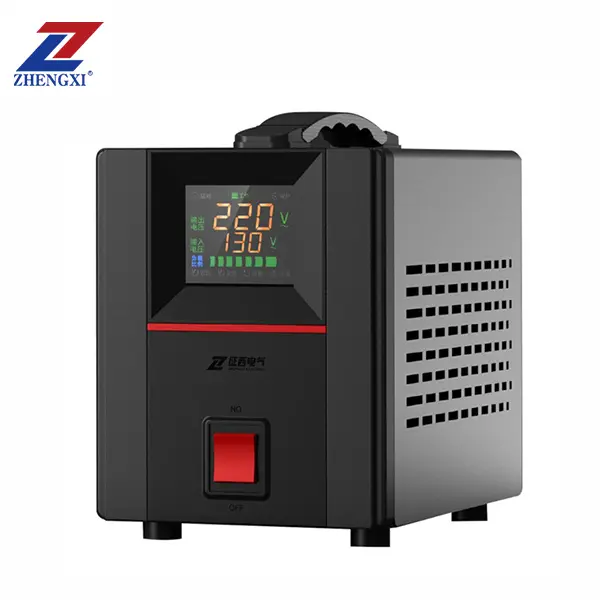


DHB Relay Wall LED Automatic Voltage Regulator For Home
DEB 0.5Kva-10Kva Wall Voltage Stabilizer With Current Display
DFB 5Kva-30Kva Home Wall Mount Voltage Stabilizer
DMB 0.5Kva-15Kva Home Wall Mount Voltage Stabilizer
Why Choose ZHENGXI‘ Stabilizer


Self-developed PCB circuit boards
ZHENGXI's in-house developed PCB are continuously optimized through customized circuit design, delivering superior performance, stability, and reliability.
Digital and Liquid Crystal Display
The high-resolution LCD screen provides clear, real-time voltage monitoring, making operation, adjustment, and status tracking more convenient and efficient.
High-Quality Housing Materials
Made from premium PC/ABS and metal materials with a UV-coated finish, our products offer enhanced durability, impact resistance, heat resistance, and a premium appearance.
Free Customization for Small Orders
Small-batch orders qualify for complimentary UV printing customization, allowing you to personalize product branding while reducing tooling and mold costs.
High reliability
simple structure, low failure rate, strict quality control to ensure reliability under various operating conditions.
Cost-effective
low manufacturing and maintenance costs, economical operation, suitable for users with limited budgets.
Multiple Protection Functions
Built-in over-voltage, under-voltage, overload and short-circuit protection to enhance equipment safety and service life.
Energy-efficient and green
high energy efficiency, reducing energy consumption and carbon emissions.
Why Choose ZHENGXI as Your Voltage Stabilizer Manufacturer?
ZHENGXI specializes in manufacturing voltage stabilizers, transformers, and power quality solutions for global markets, providing OEM and ODM services for customers worldwide.
20+
Years Experience
100+
Skilled Workers
14
Production Lines
OEM
ODM Services
Certifications & Compliance
ISO9001
ISO14001
ISO45001
CE
RoHS
IEC Standards
Quality Testing
Load Testing
Voltage Accuracy
Aging Testing
Temperature Rise
Final Inspection
Global Markets
Southeast Asia
Middle East
Africa
Europe
South America
80+ Countries Served. ZHENGXI has delivered reliable voltage stabilization solutions to customers worldwide, supporting residential, commercial, and industrial power applications.
What Is an Electronic Voltage Stabilizer?
An Electronic Voltage Stabilizer, also known as a Relay Voltage Stabilizer or Automatic Voltage Regulator (AVR), is a device designed to maintain a stable output voltage even when the input voltage fluctuates.They provide fast voltage correction, reliable protection, and economical performance for residential, commercial, and light industrial applications.
When the incoming voltage rises above or falls below the preset range, the electronic control circuit automatically activates the relay switching system. The stabilizer adjusts the transformer taps to compensate for the voltage variation and delivers a stable output voltage to connected equipment.
Electronic voltage stabilizers are widely used in homes, offices, schools, hospitals, and commercial settings where voltage fluctuations are frequent or voltage levels are low.
- Faster response speed
- Lower maintenance requirements
- Compact design
- Lower purchase cost
- High operating efficiency
How Does an Electronic Voltage Stabilizer Work?
1
Voltage Detection
The microcontroller continuously monitors the incoming voltage and checks for fluctuations outside the preset operating range.
2
Signal Processing
When a voltage deviation is identified, the control board instantly calculates the amount of correction required.
3
Relay Switching
The relay system automatically selects the appropriate transformer tap based on the detected voltage condition.
4
Voltage Correction
The output voltage is adjusted and maintained close to the rated level, ensuring stable power delivery.
Typical Working Process
Input Voltage
→
Detection Circuit
→
Relay Control System
→
Transformer Tap Switching
→
Stable Output Voltage
Fast Automatic Response: The entire correction cycle is completed within milliseconds. This rapid response helps protect sensitive electronic equipment from voltage fluctuations while maintaining a stable and reliable power supply.
Applications of Electronic Voltage Stabilizers
❄️
Voltage Stabilizer for Air Conditioner
Air conditioners are highly sensitive to voltage fluctuations. Low voltage can damage compressors, reduce cooling efficiency, and increase energy consumption. An electronic voltage stabilizer helps ensure reliable performance and extends equipment lifespan.
🧊
Voltage Stabilizer for Refrigerator
Refrigerator compressors require stable voltage for smooth startup and continuous operation. Frequent voltage drops can shorten compressor life, reduce efficiency, and lead to higher maintenance costs over time.
📺
Voltage Stabilizer for Television
Modern LED and OLED televisions contain sensitive electronic circuits that can be affected by unstable power. Electronic stabilizers help protect displays and internal components from surges and sudden voltage spikes.
💻
Voltage Stabilizer for Computer
Computers, servers, and networking equipment require continuous stable power for reliable operation. Voltage stabilizers help prevent unexpected shutdowns, hardware failures, system crashes, and potential data loss.
🏥
Voltage Stabilizer for Medical Equipment
Hospitals, laboratories, and healthcare facilities rely on precise and uninterrupted electrical power. Voltage stabilizers help ensure the safe operation of diagnostic systems, monitoring devices, imaging equipment, and other critical medical technologies.
Why Voltage Stabilizers Matter
From household appliances to mission-critical medical systems, electronic voltage stabilizers play an important role in protecting equipment from voltage fluctuations, improving operational reliability, reducing downtime, and extending service life.
Electronic vs Servo vs Static Voltage Stabilizer
| Feature | Electronic Stabilizer | Servo Stabilizer | Static Stabilizer |
|---|---|---|---|
| Technology | Relay Switching | Servo Motor | SCR / IGBT |
| Accuracy | ±10% | ±3% | ±1% |
| Response Speed | Fast | Medium | Ultra Fast |
| Maintenance | Low | Medium | Very Low |
| Cost | Low | Medium | High |
| Reliability | High | High | Very High |
| Best Application | Home Appliances | Industrial Equipment | Data Centers |
🏠
Electronic Stabilizer
A cost-effective solution for residential applications, offering fast voltage correction, simple operation, and low maintenance requirements.
🏭
Servo Stabilizer
Provides higher voltage accuracy and is widely used in industrial environments where equipment requires more precise voltage regulation.
🖥️
Static Stabilizer
Delivers the highest accuracy and fastest response time, making it ideal for data centers, medical systems, and mission-critical loads.
How to Choose the Right Electronic Voltage Stabilizer?
1
Load Capacity
Calculate the total power consumption of all connected equipment. Selecting a stabilizer with sufficient capacity helps ensure reliable operation and allows room for future expansion.
2
Input Voltage Range
Choose a voltage stabilizer that matches local grid conditions. Areas with frequent voltage fluctuations may require a wider input voltage range for effective protection.
3
Output Accuracy
The required output precision depends on the application. Sensitive electronics, medical equipment, and data systems typically require higher voltage regulation accuracy.
4
Number of Phases
Select the correct phase configuration according to your electrical system requirements.
Single Phase
Three Phase
Essential Protection Features
⚡
Surge Protection
🔋
Overload Protection
🛡️
Short Circuit Protection
Selection Tip: The ideal electronic voltage stabilizer should provide adequate capacity, a suitable input voltage range, the required output accuracy, the correct phase configuration, and comprehensive protection features to ensure long-term equipment safety and performance.
FAQ
What is the difference between a voltage stabilizer and a voltage regulator?
Both terms are often used interchangeably. A voltage stabilizer generally refers to equipment that automatically maintains stable output voltage despite fluctuations in input voltage.
Can a voltage stabilizer save electricity?
A voltage stabilizer primarily protects equipment and improves operating efficiency. It does not directly reduce electricity consumption but can prevent energy losses caused by abnormal voltage conditions.
How long does an electronic voltage stabilizer last?
With proper installation and maintenance, high-quality electronic voltage stabilizers typically operate reliably for 8–15 years.
Is a relay voltage stabilizer suitable for home use?
Yes. Relay voltage stabilizers are one of the most economical and reliable solutions for protecting household appliances.
Do I need a stabilizer for an inverter air conditioner?
In areas with unstable power supply, a voltage stabilizer can help protect inverter air conditioners from voltage fluctuations and prolong equipment life.
What size voltage stabilizer do I need?
The stabilizer capacity should be at least 50%–60% higher than the total connected load.

